
ViPN: The VPN Alternative for Users, Sites and Apps
Few organisations ever designed their VPN setup. It grew. A client VPN for people working from home, a site-to-site tunnel when the second office opened, another one for the warehouse, an IPsec link to a supplier, each with its own rules on its own appliance. That setup is now under pressure from the vendors themselves. Fortinet removed SSL VPN tunnel mode from all FortiGate models as of FortiOS 7.6.3, the smaller G-series models have no SSL VPN at all, and FortiOS 7.4, the last branch where tunnel mode stays available, stops getting bug fixes on 11 May 2027. For many E-series models the hardware itself is at its end: the FortiGate 60E reaches end of support on 29 December 2026, and the 60F that replaces it no longer supports SSL VPN on FortiOS 7.6. Fortinet's recommended path is IPsec VPN.
That is a different protocol, but the same model: once connected, a user is on the network. ViPN takes a different route. ViPN, where the i stands for intelligent, is a new package in the Jimber SASE platform that replaces remote-access VPNs and site-to-site tunnels altogether. Access is decided by identity and policy, not by network location: users get secure remote access to the applications they are approved for, not to the network behind them, and sites connect without anyone gaining access to everything. ViPN is not a new VPN. It is the alternative to one.
Why the VPN model is the problem, not the protocol
A VPN does not give access to an application. It gives access to a network. Whoever logs in with valid credentials can usually see far more than the two or three applications they actually use, and so can anyone who steals those credentials.
That is how attacks start today. In 56% of the incidents Sophos analysed for its 2025 Active Adversary Report, attackers logged in through external remote services such as VPNs and firewalls using valid credentials. In Verizon's 2025 Data Breach Investigations Report, edge devices and VPNs made up 22% of the targets of vulnerability exploitation, up from 3% a year earlier.
The gateways themselves keep appearing on the list of actively exploited flaws. Between 1 August and 17 November 2026, CISA added twelve vulnerabilities in firewalls and VPN gateways from Cisco, Citrix, Check Point, Ivanti and SonicWall to its Known Exploited Vulnerabilities catalogue. One of them, in Check Point's site-to-site and remote-access VPN, allowed code execution without a login. Moving from SSL VPN to IPsec does not change that picture, as the comparison of IPsec and SSL VPN shows.
What ViPN replaces: remote-access VPN and site-to-site VPN
| Aspect | VPNs and site-to-site tunnels | ViPN |
|---|---|---|
| Access for remote users | Network-level access after login | Access to approved applications only, checked per connection |
| Exposure | A VPN service on the firewall, reachable from the internet | An encrypted route to one application, opened after verification |
| Connecting sites | A tunnel per pair of locations, configured per appliance | A Network Controller per site, with the path chosen centrally |
| Traffic rules | Spread across appliances and tunnel configurations | One identity-based policy for users, devices and sites |
| Management | Per device and per location | One cloud console for all sites and users |
How ViPN works
ViPN is built on technology that already runs in the Jimber SASE platform. Four building blocks work together and are managed from the same cloud console.
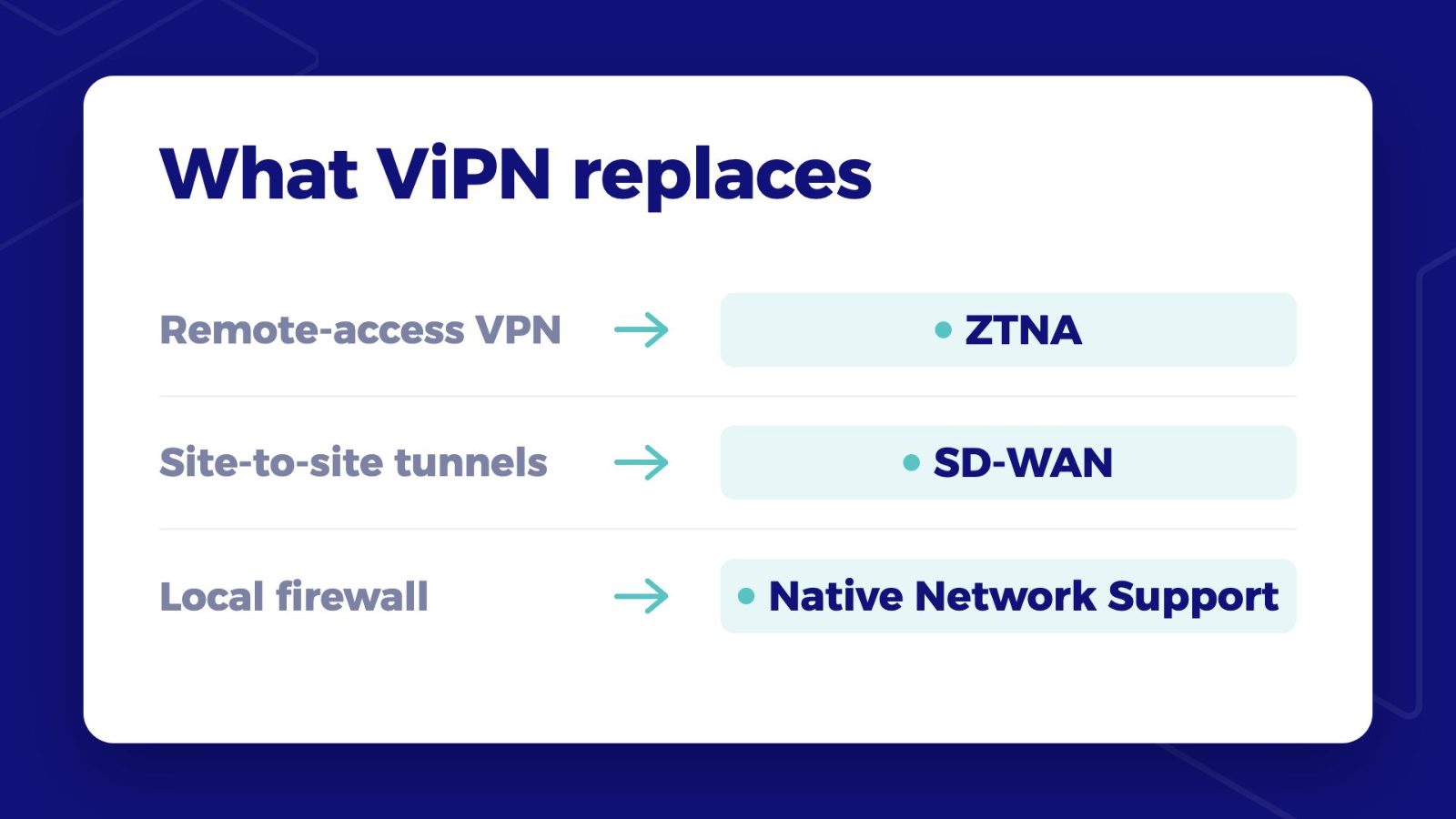
Access per application instead of per network: ZTNA
Zero Trust Network Access gives each user secure access to the approved private applications they need, without exposing the wider network. Access is based on user identity and policy, not on being connected to the network. That is what zero trust remote access means in practice.
Sites connected without a tunnel per pair: SD-WAN
SD-WAN connects branches and sites, with automatic path selection across the configured connections. Network Controllers connect the networks at each location, SD-WAN selects the permitted paths between them, and the firewall policy controls which traffic can pass. A new location joins the same central policy instead of adding another set of tunnels.
Replace the local firewall: Native Network Support
Native Network Support is part of ViPN and makes it possible to replace the local firewall at a location. The firewall rules for that site are then managed in the same console as remote access and the connections between sites.
A Network Controller at every site
Each location connects to the platform through a Jimber Network Controller, as a physical or a virtual appliance.
Who ViPN is for
ViPN fits organisations where connectivity comes first: people and sites need secure access to private applications and networks. Typical situations are:
- You are replacing remote-access VPNs with access based on user identity and policy. For FortiGate customers, SSL VPN tunnel mode is gone in FortiOS 7.6.3 and on the smaller G-series models, and the FortiOS 7.4 support dates set the latest moment to decide. Other vendors are following the same path, as the SSL VPN deprecation timeline per vendor shows.
- Multiple offices, branches or industrial sites need secure connectivity between them.
- You need to control traffic between users, devices, sites and private applications from one place.
How to replace your VPN step by step
The migration plan depends on your applications and sites, and it does not have to happen in one step. A practical order is to start with the users and applications that depend on the VPN today, then connect the sites, and switch off the VPN service once nothing relies on it anymore. The six-step VPN to ZTNA migration plan describes that sequence in detail.
For FortiGate customers, the timing is set by the upgrade path. SSL VPN settings are not carried over when a FortiGate moves to FortiOS 7.6.3 or later, so the remote-access decision has to be made before that upgrade, not after it. Choosing ViPN at that point avoids rolling out a new VPN client only to replace it again later.
ViPN, SSE or SASE: choosing the right package
The Jimber SASE platform now comes in three packages, built on the same technology and managed from the same console.
| Package | Focus | Best fit when |
|---|---|---|
| ViPN | Connectivity: ZTNA, SD-WAN, Native Network Support, physical or virtual Network Controllers | Users and sites need secure access to private applications and networks |
| SSE | Endpoint and cloud security: Secure Web Gateway, EDR, device posture, cloud authentication, Firewall as a Service per device | Most work happens in SaaS and web applications and offices do not need to be connected |
| SASE | ViPN and SSE combined | Both connectivity and endpoint and cloud security are needed in one platform |
Organisations that start with ViPN can add endpoint and cloud security later by moving to SASE, without changing platform or console.
Built and hosted in Europe
The Jimber SASE platform is built in Europe and hosted in the EU. Remote access and site connectivity stay on a European platform, delivered through European partners.
Replace the VPN, not just the protocol
Vendors are retiring SSL VPN, and the gateways that remain keep showing up on the list of exploited vulnerabilities. Replacing one VPN protocol with another keeps the same network-level access and the same exposed service. ViPN replaces the VPN itself: access per application for users, connected sites without tunnels per pair, one policy for everything, managed centrally. The quickest way to see how it fits your network is to try it for free, or to book a demo and walk through your sites and applications with the team. To compare the three packages, see packages and pricing.
Frequently asked questions
What is ViPN?
ViPN, where the i stands for intelligent, is a package in the Jimber SASE platform that connects remote users, sites and private applications without a VPN. It combines ZTNA, SD-WAN and Native Network Support with physical or virtual Network Controllers, managed from one cloud console. Native Network Support makes it possible to replace the local firewall at a site.
Is ViPN a VPN?
No. A VPN connects a device to a network. ViPN gives each user identity-based access to the approved private applications they need, without exposing the wider network. Sites are connected through Network Controllers and SD-WAN instead of site-to-site tunnels.
What is the difference between ZTNA and a VPN?
A VPN authenticates a user once and then connects their device to the network. ZTNA verifies the user, the device and the requested resource for every connection and only opens a route to that one application. ViPN uses ZTNA for remote access and adds SD-WAN to connect sites and Native Network Support to replace the local firewall.
What is a good VPN alternative for business?
For most businesses, the alternative combines ZTNA for remote users with a way to connect sites that does not rely on site-to-site tunnels. ViPN brings both together in one package, managed from one console, and organisations can add endpoint and cloud security later with SASE.
Can ViPN replace FortiGate SSL VPN?
Yes. ViPN replaces remote-access VPNs, including FortiGate SSL VPN, and site-to-site tunnels. The migration plan depends on your applications and sites. Because SSL VPN settings are not migrated when a FortiGate is upgraded to FortiOS 7.6.3 or later, it is best to plan the move to ViPN before that upgrade.
Do we need a physical appliance at every site?
No. Network Controllers are available as physical appliances and as virtual appliances that run on existing virtual infrastructure.
When is SSE a better fit than ViPN?
SSE fits organisations whose work happens mainly in cloud applications and that need endpoint and web security without connecting office networks. Organisations that need both choose SASE, which combines ViPN and SSE.