
Firewall as a Service (FWaaS)
Network security that follows your users, not your hardware
Move firewall inspection and policy to the cloud, so every office, remote worker and cloud connection gets the same protection without a box in every server room. Cloud-managed and built into the same console as your other network controls, so a small IT team runs one policy instead of patching firewalls at every site.
- Enforce one firewall policy across every location and user
- Segment your network without VLAN sprawl or manual rule sets
- Replace per-site hardware with a cloud-delivered service

What is Firewall as a Service (FWaaS)?
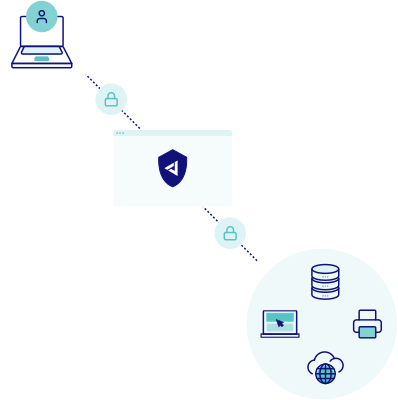
FWaaS is firewall protection delivered from the cloud instead of from a physical appliance. Traditional firewalls sit at the edge of each office and inspect traffic as it passes through. FWaaS moves that inspection to a cloud platform, so traffic from offices, remote workers and cloud apps is checked against the same policy wherever it comes from. Jimber delivers FWaaS as part of its SASE platform, so firewall policy, web filtering, access control and connectivity live in one cloud-managed console rather than in separate appliances that each need their own rules and patching.
One policy
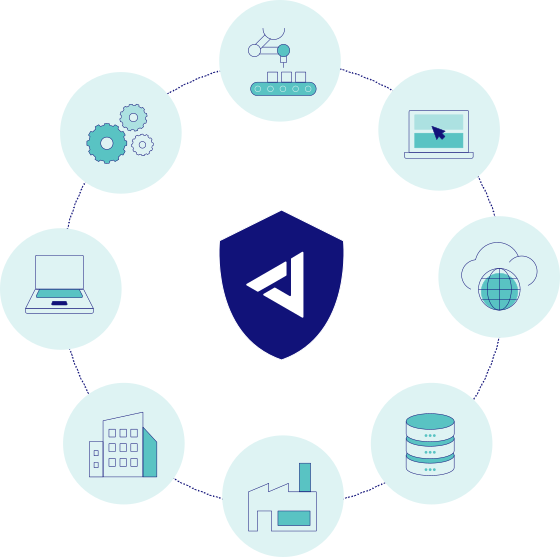
Write firewall rules once and apply them to every user, office and branch at the same time.
Full inspection
Stateful inspection, intrusion prevention and application control on web and non-web traffic alike.
No hardware
Send a site's traffic to the nearest cloud point of presence instead of installing and patching a local firewall.
How FWaaS works
Why you should choose Firewall as a Service (FWaaS)
- Ransomware now features in a large share of confirmed breaches, and small and mid-sized organisations are hit disproportionately hard, often because flat internal networks let an infection spread.
- Attackers increasingly exploit internet-facing firewall and VPN appliances as a way in, and exploitation has become one of the leading routes to initial access.
- Most web traffic is now encrypted, which creates a blind spot for hardware firewalls that lack the headroom to decrypt and inspect at scale.
- Managing separate firewalls at every branch leads to rule sprawl, configuration drift and temporary rules that quietly stay open for years.
Key Capabilities
- Inspection
- Stateful inspection and deep packet inspection: track sessions and inspect the actual payload, not just ports and protocols.
- Intrusion prevention: scan live traffic against exploit signatures and block network-level attacks as they happen.
- Control
- Application control: identify and govern specific applications regardless of the port or protocol they use.
- URL and DNS filtering: block malicious or non-compliant destinations at the domain and address level.
- Policy
- Identity-aware rules: tie firewall policy to users, groups and device posture instead of static IP addresses.
- Centralised policy: change a rule once and push it to every user, office and branch at the same time.
- Operations
- Single console: manage FWaaS alongside ZTNA, SWG, SD-WAN and inline isolation from one cloud-managed dashboard.
- Unified logging: one normalised log stream across all traffic for audit-ready reporting.
Why Jimber for FWaaS
- Simple rollout and operations from one cloud-managed console, with no firewall hardware to install or patch at each site.
- Zero Trust by default, with identity-aware, default-deny policy rather than implicit trust inside the network.
- Partner-first multi-tenant model that lets MSPs run firewall policy across customers with clear margins.
- Reliable European platform aligned with GDPR and NIS2, hosted entirely within the EU and outside foreign jurisdiction.
See Jimber in action
Give your network one firewall policy that follows users across every office, branch and remote connection. Get a guided walkthrough of the cloud-managed console and see how FWaaS, segmentation and the rest of the platform work together from a single dashboard.
FAQs about Firewall as a Service
What is the difference between FWaaS and a traditional firewall?
A traditional firewall is a physical appliance that inspects traffic at the edge of one location. FWaaS delivers the same next-generation firewall capabilities from the cloud, so policy and inspection follow your users and sites instead of being tied to a box in each office. There is no hardware to patch or replace.
Is FWaaS the same as a Secure Web Gateway?
No. A Secure Web Gateway inspects outbound web traffic over HTTP and HTTPS. FWaaS covers all traffic, including non-web protocols, server-to-server connections and internal east-west flows. On the Jimber platform the two run together, with the gateway handling web traffic and FWaaS handling everything else.
How does FWaaS stop ransomware from spreading?
Through microsegmentation. Instead of a flat network where everything trusts everything else, FWaaS draws logical boundaries around devices and workloads. If one machine is infected, it stays isolated in its own segment and cannot reach the file shares, backups and neighbouring systems that ransomware relies on to spread.
Do I still need firewalls at each office?
No. Each site sends its traffic to the nearest cloud point of presence, where FWaaS applies inspection and policy. Adding a new branch means pointing its router at the cloud, not shipping and configuring another appliance.
Does FWaaS help with NIS2 and DORA compliance?
Yes. Both expect organisations to control access and segment their networks, and DORA adds regular firewall rule review for financial entities. FWaaS provides identity-aware segmentation and centralised policy, and the single console keeps the logs and audit trail those obligations assume.
What about devices that cannot run an agent?
FWaaS policy reaches them through Jimber’s NIAC hardware. The appliance bridges agentless devices such as printers, cameras and industrial equipment inline and hands their traffic to the cloud firewall, so the same default-deny policy applies to the IT-OT parts of the network.
Where is my network traffic inspected?
Within the EU. Jimber is built and hosted entirely in Europe, which keeps traffic inspection and logging under European jurisdiction and supports GDPR and NIS2 audit requirements.