
Endpoint detection and response (EDR)
Stop threats at the endpoint, before they spread
Catch malicious files, ransomware behaviour and command-and-control traffic the moment they appear on a device. Cloud-managed and built into the same console as your network controls, so a small IT team can detect and contain incidents without a dedicated SOC.
- Detect malware, anomalies and unsigned binaries in real time
- Contain a compromised device automatically, in seconds
- Manage endpoint and network security from one console

What is Endpoint Detection and Response (EDR)?
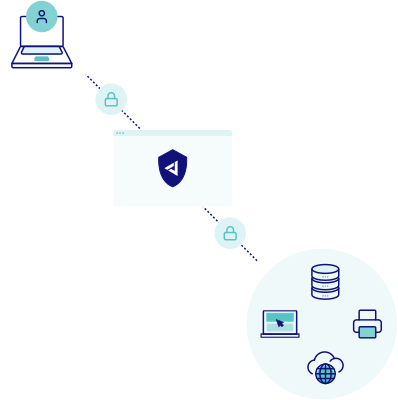
EDR is endpoint security that keeps watching after a file runs. Traditional antivirus checks a file at the door and stops looking once it is allowed in. EDR records what every process does, spots suspicious behaviour as it happens, and can isolate the device before an incident spreads. Jimber delivers EDR as part of its SASE platform, so endpoint signals and network policy live in the same cloud-managed console rather than in a separate tool with its own agent and dashboard.
Watch
Continuously log process activity, file changes and network connections on each device.
Detect
Flag malicious files, ransomware-style behaviour and command-and-control traffic in real time.
Contain
Flag malicious files, ransomware-style behaviour and command-and-control traffic in real time.
How EDR works
Why you should choose Endpoint Detection and Response
- Ransomware appeared in roughly half of confirmed breaches in the most recent Verizon DBIR, and vulnerability exploitation has become a leading route to initial access.
- Attacker dwell time is now measured in days, not weeks, which leaves little room for manual log review.
- Once an attacker uses trusted, signed system utilities, traditional antivirus and perimeter firewalls tend to look straight past them.
- A single compromised endpoint on a flat network gives an attacker a path to databases, file servers and the rest of the business.
Key Capabilities
- Detection
- Malicious file blocking: match files against threat intelligence and stop known payloads before they run.
- Behavioural detection: identify ransomware-style file activity and suspicious process behaviour without relying on signatures.
- Response
- Automated isolation: contain a compromised device at the network level the moment a high-confidence threat is detected.
- Rollback recovery: restore files changed during an attack from local shadow copies.
- Visibility
- Forensic timeline: see an attack's chain of events from first execution to final action in one view.
- Correlated logging: combine endpoint events with network and access logs for audit-ready incident records.
- Operations
- Single console: manage EDR alongside ZTNA, SWG, FWaaS and SD-WAN from one cloud-managed dashboard.
- Pre-tuned policies: high-confidence detection rules out of the box, so lean teams are not buried in noise.
Why Jimber for EDR
- Simple rollout and operations from one cloud-managed console, with no separate endpoint platform to learn.
- Zero Trust by default, so a compromised device loses its access the moment it is flagged, not at the next login.
- Partner-first multi-tenant model that lets MSPs run endpoint security across customers with clear margins.
- Reliable European platform aligned with GDPR and NIS2, hosted entirely within the EU and outside foreign jurisdiction.
See Jimber in action
Give your team endpoint detection that contains threats automatically and reports cleanly for audits. Get a guided walkthrough of the cloud-managed console and see how EDR, network controls and device isolation work together from a single dashboard.
FAQs about Endpoint Detection and Response
What is the difference between EDR and antivirus?
Antivirus checks a file against known threats and stops watching once it runs. EDR keeps monitoring process behaviour after execution, so it can catch threats that antivirus misses, such as new ransomware strains and attacks that abuse trusted system tools.
Do I need a security team to run EDR?
No. Jimber’s EDR ships with pre-tuned detection rules and automated containment, so a generalist IT team can run it without a dedicated security operations centre. Alerts are written to be acted on, not endlessly triaged.
How does EDR stop ransomware?
It watches for the behaviour rather than the file. When a process starts mass-encrypting files, the engine halts it and restores the affected files from local shadow copies, even if the ransomware strain has never been seen before.
How does EDR fit with the rest of the Jimber platform?
EDR runs in the same console as ZTNA, Secure Web Gateway, Firewall-as-a-Service and SD-WAN. Endpoint signals feed network policy directly, so a flagged device can be isolated automatically while users elsewhere keep working.
Does EDR help with NIS2 and DORA compliance?
Yes. Both expect organisations to detect, contain and report incidents quickly. EDR provides the continuous detection, automated response and forensic records those obligations assume, and the platform keeps the logs you need for reporting.
What about devices that cannot run an agent?
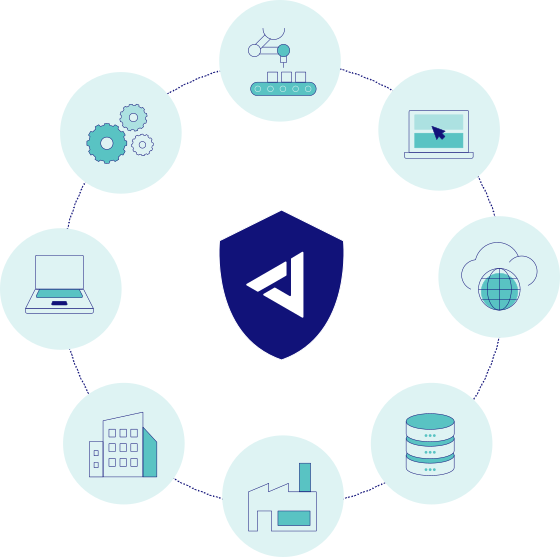
EDR covers laptops, desktops and servers. For printers, cameras, IoT and industrial equipment that cannot run software, Jimber’s NIAC hardware applies inline isolation so those devices stay under the same Zero Trust controls.
Where is my endpoint data stored?
Within the EU. Jimber is built and hosted entirely in Europe, which keeps endpoint and incident data under European jurisdiction and supports GDPR and NIS2 audit requirements.