
IPsec vs SSL VPN in 2026: Replacement or Stopgap?
IPsec is a real replacement for SSL VPN as a protocol, but not as a security model. Moving remote users to IKEv2/IPsec removes the web portal that most SSL VPN attacks went through, and it follows what NSA and CISA have recommended since 2021. It does not change what a connected user can reach, and it keeps an internet-facing VPN service on the firewall, a service attackers have started to exploit as well.
So the honest answer depends on the firewall and on the users. Where the firewall stays for years and people need full network access, IPsec is the right move. Where the firewall is near the end of its support, or where people only need a few applications, IPsec mostly buys time. This page compares the two protocols on attack surface, vulnerability history, client support, blocked networks and access model, and ends with a decision guide.
What firewall vendors recommend now
The direction is IKEv2/IPsec as the client protocol, with SSL VPN removed, made optional or still offered depending on the vendor. None of them presents IPsec as the end state; most also sell a ZTNA product alongside it.
| Vendor | Current position on remote access |
|---|---|
| Fortinet | SSL VPN tunnel mode removed from FortiOS 7.6.3 and replaced with IPsec VPN; IPsec over TCP for networks that block UDP, with IKEv2 only |
| Palo Alto Networks | GlobalProtect prefers IPsec and used to fall back to SSL automatically; an IPsec-only mode now keeps the app disconnected instead of falling back |
| Cisco | Secure Client supports both SSL and IPsec-IKEv2; Cisco Secure Access does not fail over automatically from IPsec to TLS/DTLS |
| Check Point | Remote access runs on IKE/IPsec with SSL-based components alongside; Check Point calls IKEv1 a deprecated protocol in its 2026 hotfix notice |
| SonicWall | Firewall SSL VPN still offered; the SMA 100 SSL VPN appliances have reached end of support |
| Sophos | The standalone SSL VPN client ended in January 2022, replaced by Sophos Connect for IPsec and SSL |
| WatchGuard | Mobile VPN with SSL and with IKEv2 both maintained in Fireware 2026 releases |
Source: vendor release notes and documentation from Fortinet, Palo Alto Networks, Cisco, Check Point, SonicWall, Sophos and WatchGuard.
The full timeline of who removes what, and when, lives in the SSL VPN deprecation timeline per vendor. For FortiGate in particular, the Fortinet SSL VPN article covers the 7.6.3 change, and the G-series overview shows that no G model keeps SSL VPN.
Is IPsec the replacement for SSL VPN, or a stopgap?
IPsec replaces the protocol and closes the most attacked door, the SSL VPN web portal. It is a stopgap when the reason to move is the firewall's remaining life, or when users only need specific applications: then the client rollout, certificates and MFA work is done once for IPsec and has to be done again for what comes next.
Three questions decide which of the two applies. How long will this firewall stay? If its end of support is within one or two renewal cycles, a new client and authentication setup on that firewall has a short life. What do users actually reach? Admins and developers who need SSH, RDP and broad network access are well served by a full tunnel. Staff who use a handful of web and file applications are not, because a full tunnel gives them far more reach than they need. Does the client change anyway? On FortiGate, IPsec over TCP needs a licensed FortiClient; the free FortiClient VPN does not support it. If every laptop gets new software regardless, that is the moment to pick the end state, not an intermediate one.
Vulnerability history: SSL VPN and IPsec in CISA's KEV catalogue
CISA's Known Exploited Vulnerabilities catalogue lists vulnerabilities that attackers are known to exploit. Counting the VPN-related entries added since 2023 for the main firewall vendors shows where attacks landed, and that the IPsec side is not immune.
| Vendor | SSL VPN and web remote access | IKE and IPsec |
|---|---|---|
| Fortinet | 2 | 0 |
| SonicWall | 6 | 0 |
| Palo Alto Networks | 1 | 0 |
| Cisco | 6 | 1 |
| Check Point | 1 | 2 |
| WatchGuard | 0 | 2 |
| Zyxel | 0 | 1 |
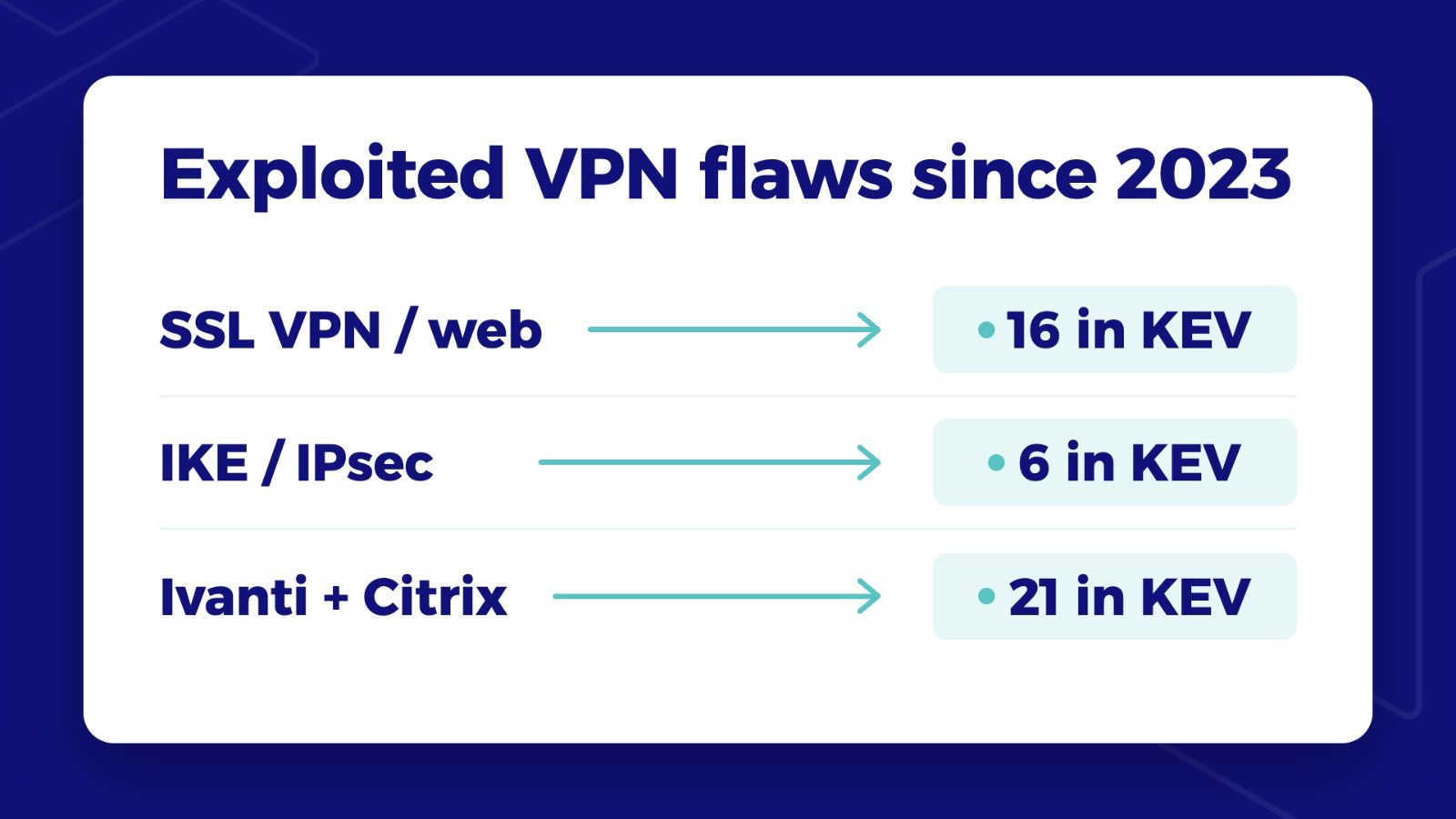
| Total | 16 (8 with known ransomware use) | 6 (2 with known ransomware use) |
Source: CISA Known Exploited Vulnerabilities Catalog, catalog version of 6 November 2026, entries added from 2023, classified by component. Where the CISA text names no component, the vendor advisory linked from the entry was used.
Two dedicated SSL VPN gateways add to the left column: Ivanti Connect Secure with 8 entries and Citrix NetScaler Gateway and ADC with 13 in the same period. One Palo Alto entry from May 2026, an authentication bypass that lets attackers "establish an unauthorized VPN connection", does not name the protocol and is left out of both columns.
The SSL VPN portal was the main target for a simple reason: it is a web application on the firewall, reachable from the internet, that handles authentication before any tunnel exists. Most of the 16 entries are pre-authentication web flaws. The newest, added by CISA on 6 November 2026, is a SonicWall SSL VPN flaw that can bypass SAML-enforced multi-factor authentication.
The right-hand column matters more than its size suggests. Four of the six IKE entries were added in 2025 and 2026: two in the WatchGuard iked process, one of them with known ransomware use, and two at Check Point, including an IKEv1 flaw that let attackers "establish a remote access VPN connection without a valid user password". The Check Point end-of-support page covers that case in detail.
IPsec vs SSL VPN: the technical comparison
| Aspect | SSL VPN (TLS) | IPsec (IKEv2) |
|---|---|---|
| Layer | TLS, usually TCP 443 | Network layer: IKE on UDP 500 and 4500, then ESP |
| Service exposed on the firewall | Web portal and TLS listener | IKE daemon |
| Standards | Vendor-specific implementations | IETF standards; preferred by NSA and CISA |
| Client | Vendor client or browser | Built-in IKEv2 clients in the operating system, or a vendor client |
| Hotel, guest and carrier networks | Works on TCP 443 almost everywhere | UDP 500/4500 or ESP often blocked; IKEv2 over TCP as the fix |
| Performance | Overhead from tunnelling over TCP possible | Native ESP is fast; TCP encapsulation adds CPU overhead |
| Access once connected | Network-level in tunnel mode | Network-level |
Source: Fortinet technical tip on dial-up IPsec over TCP (June 2025); NSA and CISA, Selecting and Hardening Remote Access VPN Solutions (September 2021); vendor documentation.
The blocked-network row is where IPsec migrations hurt. Fortinet describes IPsec over TCP as "typically used in environments where User Datagram Protocol (UDP) traffic is restricted or blocked by intermediate firewalls or carrier-grade NAT", notes that "this feature only works with IKE version 2", and warns not to bind IPsec over TCP and SSL VPN to the same interface and port. NSA and CISA advise to "configure the VPN to use IKE/IPsec and disable SSL/TLS VPN functionality and fallback options if feasible", so keeping SSL as a quiet fallback undoes part of the benefit.
What IPsec does not fix
IPsec does not change the access model. Once connected, a user, or an attacker with that user's credentials, sits on the network with the same reach as an SSL VPN tunnel user. Lateral movement is limited by segmentation and firewall policy, not by the choice of protocol.
NIST SP 800-207 describes zero trust as granting access per session and per resource, instead of trusting a connection to the network. In June 2024 CISA, the FBI and New Zealand's GCSB went a step further in their guidance on modern network access security: while some VPN solutions are more secure than others, "current hybrid networks require adopting modern network access security solutions", naming zero trust, security service edge and SASE. Read together, the 2021 guidance says which VPN to choose, and the 2024 guidance says to move beyond the VPN model.
Migration reality: moving users from SSL VPN to IPsec
Moving users is a client and network project, not a configuration change. The problems that come up in Fortinet's community and support notes repeat across vendors.
- Client and licensing. On FortiGate, IPsec over TCP requires a licensed FortiClient. Every laptop needs the new client and profile.
- Blocked networks. Hotel, guest and carrier networks block UDP 500/4500. TCP encapsulation solves most cases, but users report TCP mode timing out where UDP works, and a tunnel that loses UDP must reconnect before it fails over to TCP.
- Client conflicts. On Windows, the built-in IKEEXT service can occupy UDP port 4500 and block the vendor client.
- Authentication. SAML and MFA have to be rebuilt for IKE. On FortiOS, using the same TCP port for SAML authentication and IKE TCP encapsulation stops tunnels from establishing.
- Helpdesk. Tickets move from "the portal is unreachable" to "UDP is blocked here".
The VPN-to-ZTNA migration plan shows the same steps for a move that skips the intermediate stage.
Decision guide: IPsec, ZTNA or both
Choose IPsec when the firewall stays for several more years, when users need full network access, and when the vendor has removed SSL VPN. Patch the IKE service as quickly as you would have patched the SSL portal, and disable SSL fallback.
Choose ZTNA directly when the firewall is near end of support, when most users need specific applications rather than the network, or when a client rollout is needed anyway. ZTNA gives each user access to named applications, and the firewall no longer needs an internet-facing remote-access service at all. The IPsec VPN versus ZTNA comparison works through that choice in detail.
Use both where admins keep a full IPsec tunnel on a firewall that stays, and everyone else moves to per-application access. For a European mid-market organisation, the Jimber SASE platform delivers ZTNA with agentless access and data handled in the EU, so the step that removes network-level exposure does not add another client to every laptop. Try Free and move a first group of users before you roll out a new VPN client to everyone.
The case for staying on IPsec
An experienced network engineer who prefers IPsec would push back, and the arguments deserve an answer.
"IKEv2 with certificates is mature and standards-based, and the agencies recommend it." True, and it is the right protocol choice for a VPN. The KEV record shows six IKE entries against sixteen SSL VPN entries, so the exposure is smaller, not gone.
"ZTNA is another client and another cloud dependency." For a small team on a firewall that stays, IPsec on the existing box can be the cheapest secure option. The calculation changes when the firewall is replaced within two years or when the client changes anyway.
"Admins and developers need network-level access." Correct for those users. They are rarely the majority, and a model that gives everyone the access the admins need is the problem zero trust guidance addresses.
Conclusion
IPsec beats SSL VPN as a protocol: standards-based, no web portal, recommended by NSA and CISA, and now the default at most firewall vendors. It is not the end state. The IKE side has its own exploited vulnerabilities, four of them added in 2025 and 2026, and a connected user still reaches the network. Use IPsec where the firewall stays and users need the network, and skip it where the firewall is ageing or users only need applications.
If a client rollout is coming anyway, make it the last one. Try Free to test per-application access next to your current VPN, or book a demo to map your own user groups.
Frequently asked questions
Is IPsec more secure than SSL VPN?
IPsec removes the web portal that most SSL VPN attacks targeted, and NSA and CISA recommend standards-based IKE/IPsec over SSL/TLS VPNs. But IPsec is not immune: CISA added four exploited IKE vulnerabilities from WatchGuard and Check Point in 2025 and 2026. Both protocols still give connected users network-level access.
Is SSL VPN obsolete?
Not everywhere, but it is being removed. Fortinet replaced SSL VPN tunnel mode with IPsec from FortiOS 7.6.3, Palo Alto offers an IPsec-only GlobalProtect mode, and SonicWall's SMA 100 appliances have reached end of support. SonicWall, Sophos and WatchGuard still support SSL VPN on their firewalls.
What should replace an SSL VPN?
IKEv2/IPsec is the direct replacement where the firewall stays and users need full network access. Where access is per application, or the firewall is near end of support, zero trust network access avoids a second client migration and removes the internet-facing VPN service from the firewall.
Does IPsec work on hotel Wi-Fi?
Often not over plain UDP 500 and 4500, which many guest and carrier networks block. IKEv2 over TCP solves most cases; on FortiGate it needs a licensed FortiClient. TCP encapsulation adds CPU overhead and can be throttled by inspection devices along the way.
Should I keep SSL VPN as a fallback?
NSA and CISA advise disabling SSL/TLS VPN functionality and fallback options where feasible. A quiet fallback keeps the web portal exposed, which removes much of the benefit of moving. Palo Alto now supports an IPsec-only GlobalProtect mode for this reason.
Does IPsec stop lateral movement?
No. Once connected, an IPsec user has network-level access just like an SSL VPN tunnel user. Limiting lateral movement depends on segmentation and firewall policy, or on a per-application access model such as zero trust network access.
Which VPN vulnerabilities have been exploited recently?
CISA's catalogue lists 16 SSL VPN and web remote-access entries for the main firewall vendors since 2023, the latest a SonicWall SAML and MFA bypass added on 6 November 2026. On the IPsec side it lists six, including WatchGuard iked and Check Point IKEv1 flaws.
What do the security agencies recommend for remote access?
NSA and CISA recommended standards-based IKE/IPsec over SSL/TLS VPNs in 2021. In 2024 CISA, the FBI and New Zealand's GCSB said hybrid networks require modern network access security, naming zero trust, security service edge and SASE.
When should I skip IPsec and go straight to ZTNA?
When the firewall reaches end of support within a renewal cycle or two, when most users need specific applications rather than the network, or when every laptop needs a new client anyway. In those cases an IPsec rollout has to be repeated later.