
What Is Security Service Edge (SSE)? The 2026 Definition
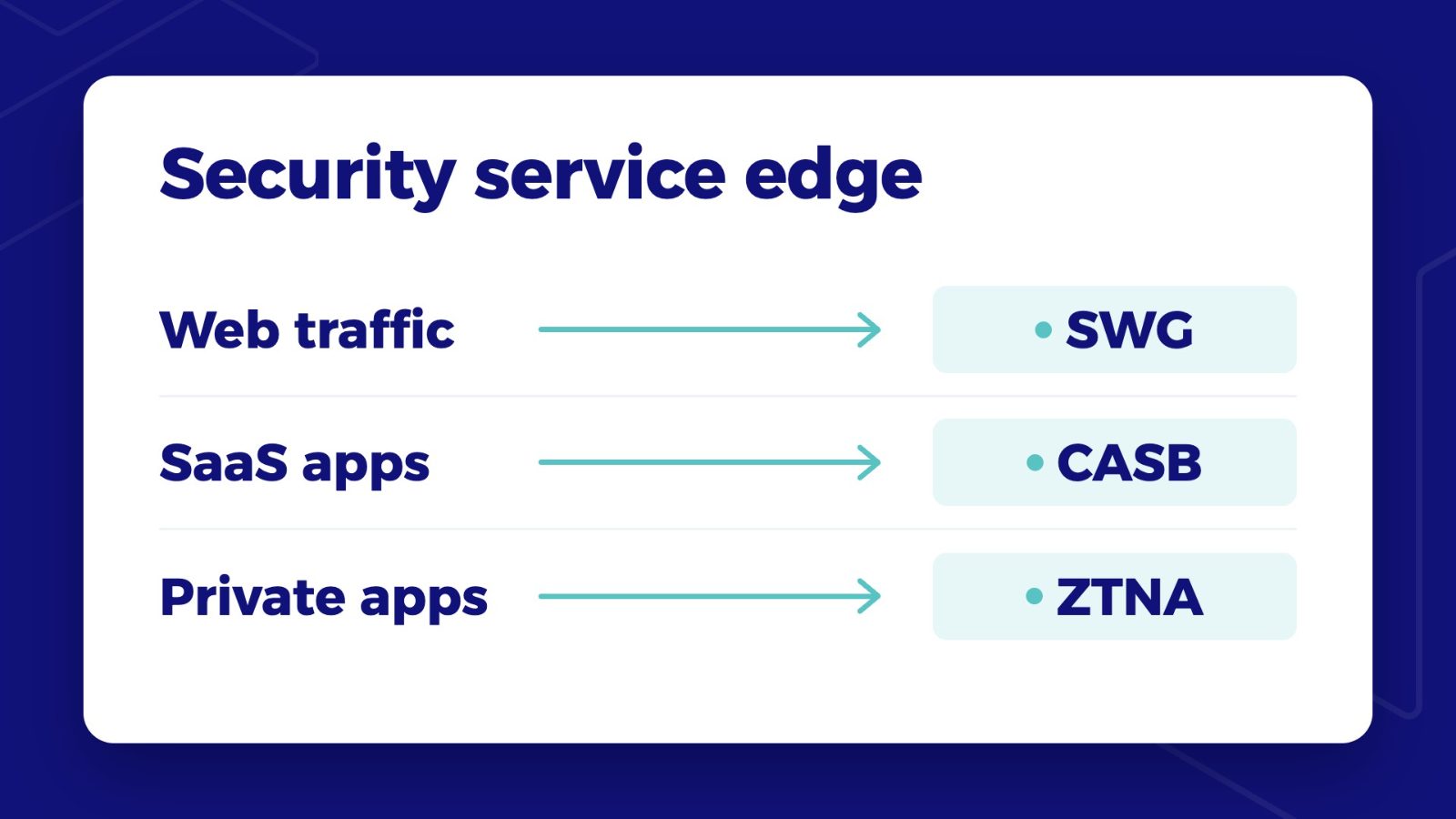
Security service edge (SSE) is a cloud-delivered set of security services that controls how users reach the web, SaaS and private applications, wherever they work. Its core is a secure web gateway, a cloud access security broker and zero trust network access; many vendors add firewall-as-a-service, data loss prevention and browser isolation.
That definition is easy to repeat and hard to apply. Vendor pages each list a slightly different set of components, the term means something else entirely to web developers, and Gartner's current definition asks for more than most checklists mention. This guide explains what SSE is, what a product has to do to count as SSE in 2026, how it differs from SASE and SD-WAN, and when SSE on its own is enough for a European mid-market organisation.
Where the term comes from
Gartner introduced security service edge as a category in 2021, according to vendors such as Zscaler and Microsoft, and has published a Magic Quadrant for SSE every year since 2022. Gartner's current definition describes SSE as "an offering that secures access to the web, cloud services and private applications regardless of the location of the user, the device they are using or where that application is hosted".
The idea behind it is practical. Applications moved to the cloud and people started working from anywhere, so routing all traffic through a firewall and a web proxy at head office stopped making sense. SSE moves those security controls to the cloud, close to the user, and applies them per identity rather than per network location.
One naming note: in web development, SSE also stands for Server-Sent Events, a browser standard for streaming data. If the context is firewalls, remote access or web filtering, SSE means security service edge. CISA's 2024 guidance writes "Secure Service Edge"; it refers to the same idea.
What SSE includes, and where definitions differ
Every definition agrees on three building blocks: a secure web gateway (SWG) for web traffic, a cloud access security broker (CASB) for SaaS applications, and zero trust network access (ZTNA) for private applications. Beyond those three, vendors and agencies disagree, most visibly about firewall-as-a-service.
| Capability | Gartner mandatory features (August 2026) | Most vendor definitions | CISA (2024) |
|---|---|---|---|
| Secure web gateway | Core, as a forward proxy with decryption | Core | Core |
| CASB | Core, inline and through API connections to SaaS | Core | Core |
| ZTNA, access to private applications | Core | Core | Core |
| Firewall-as-a-service | Not on the mandatory list | Core for most; Cloudflare calls it "often included" | Core |
| Data loss prevention | Core, as inline and API data protection | Varies: separate, or part of the web gateway | Not named |
| Remote browser isolation | Not named | Optional for Cloudflare, not named by most | Not named |
| Generative AI app protection | Core | Rarely named | Not named |
| Identity provider integration | Core | Rarely named | Not named |
| Access for devices without an agent | Core | Rarely named | Not named |
| SD-WAN | Not part of SSE | Not part of SSE | Not named in the SSE list |
Source: Gartner Peer Insights, Security Service Edge market (features updated August 2026); definition pages of Zscaler, Netskope, Palo Alto Networks, Cloudflare, Fortinet, Cisco and Microsoft; CISA, FBI and partners, "Modern Approaches to Network Access Security" (June 2024).
Vendors do not even agree with themselves. Zscaler's own definition page lists firewall-as-a-service as a core component in its introduction and leaves it out of the component list in its FAQ. The practical lesson is that "SSE" on a datasheet says little; the capabilities behind it say everything. The secure web gateway explainer and the CASB explainer go deeper into the two biggest components.
What a product has to do to count as SSE in 2026
Gartner's current definition sets six mandatory features. A product that lacks one of them is, by Gartner's yardstick, not a complete SSE, however it is marketed. Vendor glossary pages rarely quote this list, which is why many products called SSE are a cloud web proxy with a new label.
- Cloud-delivered management and data planes. Policy and inspection run primarily in the provider's cloud, not on an appliance you host.
- An identity-aware forward proxy with decryption. Web traffic is inspected per user and group, including encrypted traffic.
- Access control for devices with and without an agent. Managed laptops get an agent; contractors, partners and unmanaged devices still need a controlled route in.
- Inline protection of data and against threats in generative AI, SaaS and private apps. Generative AI is now named explicitly; the shadow AI article shows why.
- Integration with an identity provider. In practice Microsoft Entra ID or Google Workspace, so policies follow existing users and groups.
- Out-of-band protection of data in SaaS apps through API integration. The CASB also inspects data at rest in SaaS, not only traffic in transit.
Two questions belong next to this list for any European buyer. First, where is traffic decrypted, and which categories can be exempted, such as banking or health sites? Gartner makes decryption mandatory, while CISA's June 2026 guidance states that TLS break-and-inspect "is no longer a universally recommended solution" because of complexity and latency. Second, where are logs, configuration and policy data stored, and under which jurisdiction does the provider operate? An SSE provider sees every request your users make, so the answer matters as much as the feature list.
SSE versus SASE versus SD-WAN
SSE is security only. SASE (secure access service edge) adds networking, mainly SD-WAN, so branch connectivity and security run as one service. SD-WAN on its own is the networking layer: it connects sites and steers traffic over internet and WAN links.
| SD-WAN | SSE | SASE | |
|---|---|---|---|
| What it is | Networking between sites and over WAN links | Cloud-delivered security for access to web, SaaS and private apps | SD-WAN and SSE converged |
| Where it runs | Branch appliances, physical or virtual | Cloud points of presence, plus an agent or agentless access | Both |
| Gartner's vendor model | Part of SASE | Evaluated for a dual-vendor SASE strategy | Delivered as a platform by one vendor, with no more than two consoles |
| Typical fit | Several sites with WAN or MPLS to replace | Hybrid, cloud-first teams; existing WAN stays | Branch networking and security renewed together |
Source: Gartner Peer Insights, Security Service Edge and SASE Platforms markets (August 2026); Gartner Magic Quadrant for Security Service Edge abstract (29 July 2026).
The difference in Gartner's vendor model is easy to miss. Gartner evaluates SSE vendors "in the context of a dual-vendor secure access service edge strategy", in other words as the security half next to someone else's SD-WAN, while it defines SASE platforms as delivered by one vendor. The SSE versus SASE decision guide works through that choice in detail.
When SSE alone is enough, and when you need SASE
SSE on its own fits an organisation whose users mostly work in SaaS applications such as Microsoft 365 or Google Workspace, from home or from one or a few small offices on ordinary internet connections, with few private applications and an existing branch network that is not up for change.
SASE is the better fit when several branches or plants share a WAN that needs steering, when MPLS is being replaced, when branch firewalls are due for renewal, or when sites need to reach each other. Devices that cannot run an agent, such as OT or IoT equipment, also point to networking controls at the site.
The market follows the same path. Dell'Oro reported in June 2026 that SSE revenue grew 22% year on year in the first quarter, with "SSE-first rollouts remaining the most common entry point" into SASE. Most organisations start with SSE and add networking later, which makes it worth checking whether the SSE you choose can grow into SASE without a second vendor and a second console.
Jimber is built around that path. The Jimber SSE package covers the secure web gateway, CASB insights and browser isolation, device posture, cloud sign-in with Microsoft Entra ID and Google Workspace, and firewall-as-a-service, under one agent and one console. Private application access through ZTNA, SD-WAN and site connectivity sit in Jimber ViPN, and SASE combines both packages, so an organisation can start with SSE and add connectivity without changing vendor. To see how that works on your own devices: Try Free.
A checklist for European mid-market buyers
- Gartner's six features. Ask the vendor to show each of the six mandatory features in a demo, not on a slide.
- Identity. Native integration with the identity provider you already run, including groups and device context.
- Decryption policy. Where traffic is decrypted, which categories you can exempt, and how certificates reach devices.
- Agent and agentless access. Coverage for managed laptops, unmanaged devices, contractors and partners.
- One policy model. Web, SaaS and private-app rules in one policy and one console, not three products under one name.
- Data location and jurisdiction. Which points of presence your users hit, and where logs, configuration and policy data are stored.
- Firewall scope. Whether non-web traffic is controlled, since firewall-as-a-service is not mandatory for SSE.
- Evidence for NIS2. Logs and reports that support Article 21 measures such as access control policies, multi-factor authentication and the use of encryption, with export to your SIEM.
- Supplier risk. NIS2 Article 21(3) asks entities to take into account "the vulnerabilities specific to each direct supplier and service provider". An SSE provider that sees all user traffic is such a provider.
- Path to SASE. Whether networking can be added later under the same policy and console.
The NIS2 mapping above is Jimber's reading of Directive (EU) 2022/2555, not official guidance. Cost questions are covered in the SASE pricing models explainer, and the case for keeping inspection with a European provider in the European SASE alternatives article.
Market context in brief
Gartner published its latest Magic Quadrant for Security Service Edge on 29 July 2026 and calls SSE "a mature market that consolidates multiple access-related security point offerings into a single cloud-centric, converged platform". Dell'Oro reported total SASE revenue of 3.5 billion dollars in the second quarter of 2026, with growth in core SSE moderating and extensions such as data security and digital experience monitoring growing faster. Market-research firms publish SSE market-size forecasts that differ from each other by a factor of three or more, so treat any single headline figure with caution.
The case against SSE as a category
A sceptical network architect would argue three things. Strip away the acronyms and SSE starts with a forward proxy with decryption, the web proxy many organisations used to run on site, now in someone else's data centre. Gartner itself calls the market mature and evaluates it only as half of a two-vendor SASE, so teaching SSE sets buyers up for a second migration later. And sending all traffic through a third-party cloud adds a dependency, a latency hop and a supplier that sees everything.
Each point has merit. The proxy is indeed at the core, which is why the six features matter: identity awareness, agentless access, API inspection of SaaS data and generative AI controls are what separate an SSE from a relocated proxy. The second migration is a real risk, and the answer is to choose an SSE that grows into SASE under the same vendor and console. The supplier point is the strongest, and it is the reason data location, jurisdiction and NIS2 supplier assessment belong on the checklist rather than in the small print.
Conclusion: judge SSE by what it does, not by the label
Security service edge describes a real shift: security controls that follow users to the cloud instead of staying at head office. The label alone says little, because definitions differ. Judge any offering against Gartner's six mandatory features, the decryption and data-location questions, and whether it can grow into SASE without a second vendor. Jimber offers SSE as a package that grows into full SASE with ViPN, from one European vendor with one agent and one console. Try Free, or book a demo to walk through the checklist with the Jimber team.
Frequently asked questions
What is SSE in cybersecurity?
SSE stands for security service edge: a cloud-delivered security service that protects how users reach websites, SaaS applications and private applications, from any location or device. The usual building blocks are a secure web gateway, a cloud access security broker and zero trust network access, often with firewall-as-a-service and data loss prevention.
What does SSE stand for in IT?
In IT security, SSE means security service edge, the cloud-delivered security half of SASE. In web development, the same acronym means Server-Sent Events, a browser standard for streaming updates from a server. If the context is firewalls, remote access or web filtering, SSE means security service edge.
What is the difference between SSE and SASE?
SSE is security only: access controls for web, SaaS and private applications, delivered from the cloud. SASE adds networking, mainly SD-WAN, so branch connectivity and security run as one service. Gartner evaluates SSE vendors for a dual-vendor set-up and defines SASE platforms as delivered by one vendor.
What are the components of SSE?
Gartner's mandatory features of August 2026 are cloud-delivered management and inspection, a forward proxy with decryption, access control for devices with and without an agent, inline data and threat protection for generative AI, SaaS and private apps, identity provider integration, and API protection of SaaS data.
Is firewall-as-a-service part of SSE?
It depends on whose definition you use. Zscaler, Netskope, Palo Alto Networks, Fortinet, Cisco and CISA list firewall-as-a-service as an SSE component, while Cloudflare calls it often included. Gartner's 2026 mandatory SSE features do not list it, but Gartner does require Layer 7 firewalling for SASE platforms.
Is SASE the same as SD-WAN?
No. SD-WAN is the networking part: it connects sites and steers traffic across internet and WAN links. SASE combines SD-WAN with cloud-delivered security such as a secure web gateway, CASB, ZTNA and firewalling. SSE is that security part on its own. You can buy SD-WAN, SSE or both together as SASE.
Can SSE replace a VPN?
For user access to private applications, yes. The ZTNA component grants access per application, based on identity and device, instead of putting the user on the network as a VPN does. CISA's 2024 guidance recommends moving away from broad remote-access deployments. Site-to-site links still need networking, which belongs to SASE.
Does SSE have to decrypt all my traffic?
Gartner's mandatory features include a forward proxy with decryption, while CISA's June 2026 guidance says TLS break-and-inspect is no longer universally recommended because of complexity and latency. Ask vendors where decryption happens, which categories you can exempt, and how certificates are deployed to devices.
Is there a Gartner Magic Quadrant for SSE?
Yes. Gartner has published a Magic Quadrant for Security Service Edge every year since 2022. The latest edition appeared on 29 July 2026, alongside a Magic Quadrant for SASE Platforms and a Critical Capabilities report for SSE.