
Cisco Secure Access vs Umbrella: Stay With Cisco or Switch?
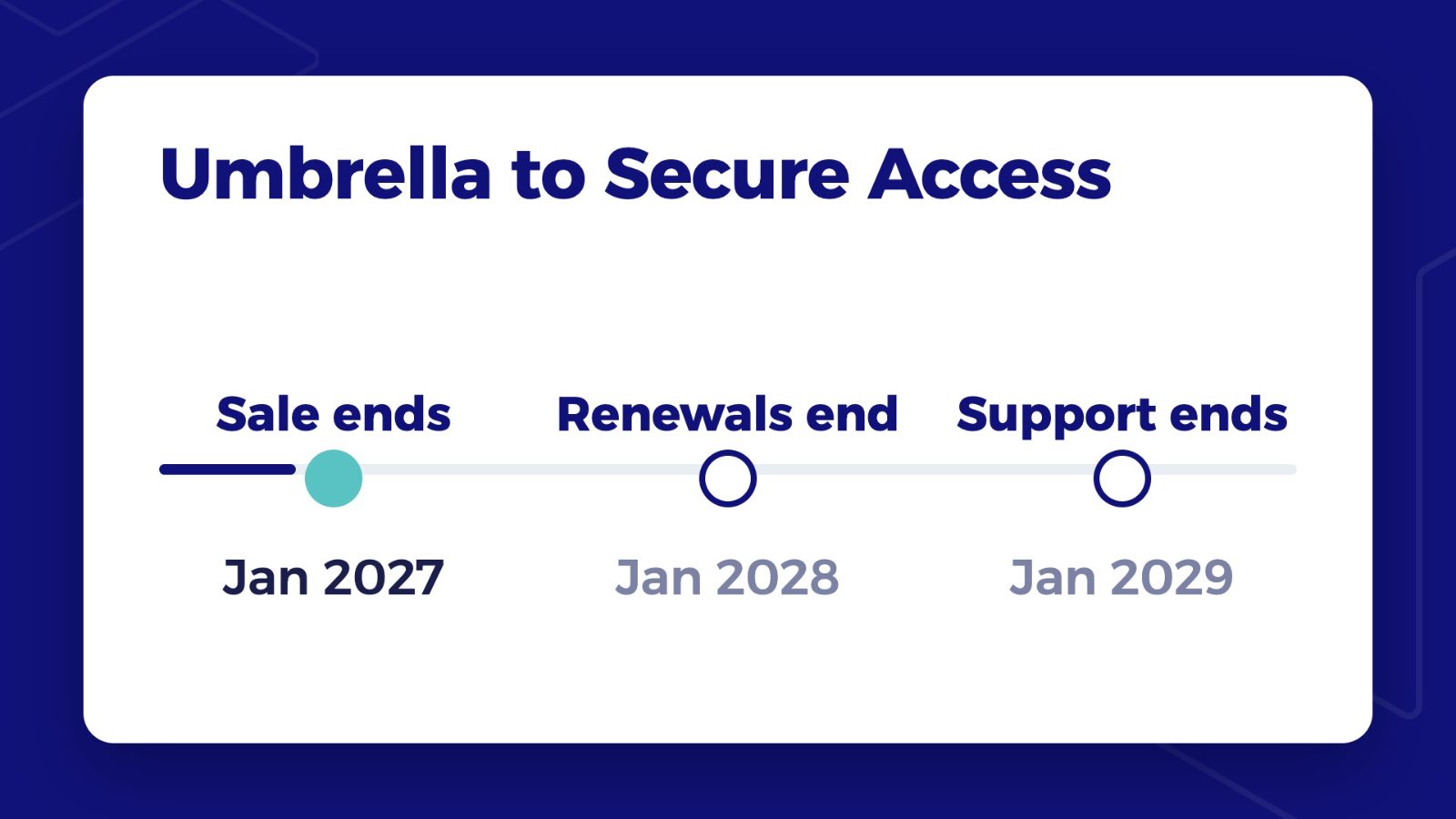
Every Cisco Umbrella customer has to move. Cisco stops selling Umbrella DNS and SIG on 31 January 2027, and the upgrade path it offers leads to one place: Cisco Secure Access. That upgrade is less of a copy than the word suggests. It creates a new tenant, translates policies into new rules, rebuilds tunnels and ends with a step that cannot be undone. A forced migration is therefore also the one moment when changing vendor costs little extra.
This page explains what Cisco Secure Access is, how each Umbrella package maps to it, what Cisco's own upgrade guides say will not carry over, what the new licence floor means and where your data ends up. It closes with the questions that decide between staying with Cisco and switching to a European SSE.
What is Cisco Secure Access?
Cisco Secure Access is Cisco's cloud-delivered security service edge (SSE). One subscription covers a secure web gateway, CASB, data loss prevention, firewall-as-a-service with IPS, remote browser isolation, DNS-layer security, zero trust network access and VPN-as-a-service, managed from Cisco Security Cloud Control with Cisco Secure Client on the endpoint.
Cisco sells it in packages, each in an Essentials and an Advantage version with optional add-ons. Secure Internet Access (SIA) covers web and SaaS traffic and includes DNS Defense. Secure Private Access (SPA) covers private applications through ZTNA and VPN-as-a-service. DNS Defense is also sold on its own. Cisco adds Experience Insights, its ThousandEyes-based monitoring, to every SIA and SPA order, and states that Cisco Secure Client is included with Secure Access at no added cost.
How each Umbrella package maps to Secure Access
Umbrella DNS Security Essentials and Advantage become Secure Access DNS Essentials and Advantage, sold as DNS Defense. Umbrella SIG Essentials and Advantage become Secure Internet Access Essentials and Advantage. A handful of add-ons have no successor at all, and Cisco's end-of-life bulletin says so in four words: "No migration product available".
| Umbrella package or add-on | Secure Access successor | What changes |
|---|---|---|
| DNS Security Essentials | DNS Essentials (DNS Defense) | Adds cloud DLP and cloud malware detection; minimum stays one user |
| DNS Security Advantage | DNS Advantage (DNS Defense) | Same additions; Secure Access does not support Intelligent Proxy |
| SIG Essentials | Secure Internet Access Essentials | Adds Experience Insights; RBI Isolate Risky becomes a paid add-on; minimum of 50 users |
| SIG Advantage | Secure Internet Access Advantage | Layer 7 firewall, IPS, extended sandboxing and more RBI; minimum of 50 users |
| L7 Cloud Firewall add-on | No migration product | Layer 7 firewalling sits in SIA Advantage instead |
| RBI Isolate Web Apps | No migration product | Discontinued |
| Reserved IP, Regional | No migration product | Discontinued |
| Investigate Integration API and Console | No migration product | Other Investigate API tiers continue |
| Umbrella bundles for Catalyst SD-WAN and DNA | No migration product | Relevant for Cisco SD-WAN customers |
Source: Cisco end-of-life bulletin EOL15975 (September 2026), Cisco Secure Access ordering guide (October 2026) and Cisco SSE package comparison guide (July 2026).
Renewals of the current packages remain possible until 31 January 2028, and support ends on 31 January 2029. The Umbrella end-of-sale versus end-of-life page sets out every milestone, so this page stays with the move itself.
What Cisco's upgrade does not carry over
Cisco's Upgrade Manager copies policies, destination lists and tunnels into a new Secure Access organisation, but not everything. Custom user roles, block page bypass codes, legacy API keys and Umbrella-hosted PAC files stay behind, policies without identities are skipped, tunnels have to be rebuilt, and the final step deletes the Umbrella organisation for good.
Cisco advertises that most customers can migrate "in an hour or less" with the automated upgrade manager. That is the time the tool needs. The work around it sits in Cisco's own guidelines and limitations, spread over more than forty help topics. Collected in one place, it looks like this.
What stays behind
- "Custom user roles are not copied over." Secure Access has its own fixed set of administrator roles.
- "Block Page Bypass Users and Codes are not copied over."
- "Legacy API keys will not transfer to Secure Access." Every integration that uses them needs new credentials.
- Secure Access does not support PAC files hosted by Umbrella. Custom PAC files have to be downloaded, edited and uploaded again.
- "Umbrella DNS, Web, and Firewall policies that do not include identities are not copied."
Limits that stop the upgrade
- Any policy or rule with more than 250 identities makes the upgrade fail.
- Destination lists with more than 250,000 entries block the upgrade.
- The automated SIG upgrade is only available with fewer than 50 network tunnels and no Catalyst SD-WAN tunnels. Above that, Cisco requires "a manual migration using a new instance".
What has to be rebuilt
- Tunnels. The Umbrella tunnels are copied as tunnel groups, but you establish new IPsec tunnels with new passphrases, configure a primary and a secondary hub, and update every site device with the new IP addresses. The Umbrella tunnels keep running during the transition.
- Administrator access. Admins move to Cisco Security Cloud Sign On in Security Cloud Control. Cisco's guide states that all users must enrol in Duo unless you configure your own identity provider, and lists admins locked out of the Umbrella dashboard as a known issue.
- Firewall rules. Bulk rule actions are not available, some Layer 7 applications do not exist in Secure Access, category contents differ, and translated schedules may leave a rule "active for a broader duration than originally intended".
- Rule order. The translation can add allow rules with "ANY" as destination, which "could prevent rules below from being processed". Every translated rule stack needs a review before traffic moves.
What cannot be undone
Umbrella keeps enforcing policy while you redirect identities to Secure Access in batches, and each redirection can be reversed until you close Umbrella. Closing is the last step, and Cisco is explicit about it: it "completely removes your Umbrella org and is not reversible". Policies created in Umbrella after the upgrade has started do not sync to Secure Access, so a change freeze belongs in the plan.
Cisco describes the upgrade tool as free of charge in its data sheet, while a support article calls the migration "a paid service available only to customers who have purchased a Cisco Secure Access subscription". In practice the tool costs nothing extra, but it only runs once a paid Secure Access subscription is in place; trial licences are not supported.
The endpoint client changes too
The standalone Umbrella roaming client is replaced by the Umbrella Roaming Security module in Cisco Secure Client. The installer keeps the existing OrgInfo.json profile and removes the old client automatically, and Cisco warns that both must never run at the same time. The roaming client end-of-life page covers that change in detail.
If this rebuild list is long for your organisation, test an alternative on a handful of devices before the upgrade starts: Try Free.
The 50-user minimum and other licensing changes
Secure Internet Access and Secure Private Access require at least 50 users per billing SKU, according to Cisco's ordering guide of October 2026; the floor used to be 100. DNS Defense keeps a minimum of one user. Subscriptions run for 12, 36 or 60 months and are priced in seven user bands, from 1-99 to 25,000 and more.
For a 30-person organisation that moves from SIG to Secure Internet Access, that means paying for 50 users. An organisation that also wants private access buys a second SKU with its own 50-user floor. Add-on quantities must match the highest seat count of the package they belong to.
The remaining Umbrella term is the other open question. Cisco's migration page promises credit for the unused balance of an Umbrella subscription, while the ordering guide calls subscription changes "a manual process" and states that "Mid-term cancellations of subscriptions for credit are not allowed". Ask your Cisco partner in writing how your remaining term is credited before you sign. The Umbrella pricing page covers what staying costs until 2029.
Where your data lives
Cisco Secure Access stores event logs in California by default. You can switch them to a European data warehouse, but existing logs stay where they are. Configuration data, including audit logs and policy settings, remains in California in every case. In Europe, zero trust access and VPN run from regions that Cisco lists as AWS-based public cloud.
- Event logs: detailed data is kept for 30 days and summary data for two years. Moving the warehouse to Europe applies to new logs only.
- Configuration data: in Cisco's words, it "remain[s] stored by Cisco in California regardless of a change to the data warehouse's location".
- Experience Insights: accounts are provisioned in the United States by default; moving to the European data centre takes a request to ThousandEyes support.
- Zero trust access and VPN: in Europe, offered from public cloud regions in France, Germany, Ireland (on request), Milan, Spain, Stockholm, Zurich and the United Kingdom, plus two UK sites in private preview. Cisco lists no location in Belgium.
Source: Cisco Secure Access Help, pages "Manage Logging", "Change the Location of Event Data Logs", "Data Retention" and "Secure Access Regions", as of November 2026.
For organisations with GDPR or NIS2 obligations, this is the section to discuss with the data protection officer before choosing. The same questions apply to every SSE vendor, including a European one: where is traffic decrypted, where are logs and configuration stored, and under which jurisdiction does the provider operate?
Three options compared
Every Umbrella customer has three realistic routes: stay on Umbrella for as long as Cisco allows, move with Cisco to Secure Access, or use the migration to switch to a European SSE such as Jimber SSE.
| Criterion | Stay on Umbrella | Move to Cisco Secure Access | Switch to Jimber SSE |
|---|---|---|---|
| How long it lasts | Renewals until 31 January 2028, support until 31 January 2029 | New 12, 36 or 60-month subscription | New subscription |
| Migration work | None now, a full migration later | Upgrade Manager plus the rebuild list above | New agent and new policies |
| Secure web gateway | Yes (SIG) | Yes | Yes |
| CASB and app visibility | Yes (SIG) | Yes | Yes |
| Browser isolation | Add-on | Add-on, more in SIA Advantage | Yes |
| Firewall-as-a-service | Yes (SIG) | Yes | Yes |
| Device posture and cloud sign-in | Not published | Posture in Secure Private Access | Yes |
| Access to private applications | No | Secure Private Access, a separate SKU | Through Jimber ViPN or SASE |
| Vendor headquarters | United States | United States | Belgium |
Source: Cisco EOL15975, Cisco Secure Access data sheet and ordering guide, Cisco SSE package comparison guide; Jimber product pages.
Staying on Umbrella buys time and nothing else. The last renewal has to end by January 2029, Umbrella receives no new capabilities, and the full migration simply moves to a busier moment.
Moving to Secure Access is the strongest route for an organisation that runs a deep Cisco stack: Secure Client already on every endpoint, Duo and ISE in the identity chain, and Catalyst SD-WAN at the sites. The upgrade path then keeps policies in a familiar form, and private access can be added in the same console.
Switching to a European SSE makes sense when the rebuild list above is long, when your sites are below the 50-user floor, or when you want inspection, logs and configuration with a European provider. Jimber SSE brings the secure web gateway, CASB insights and browser isolation, device posture, cloud sign-in with Microsoft Entra ID and Google Workspace, and firewall-as-a-service together under one agent and one console. When private applications or sites need connectivity later, the SSE package grows into full SASE with ViPN. The Umbrella versus Jimber comparison goes deeper into the differences, and the 60-day migration plan shows what a switch looks like week by week.
The questions that decide
- How much of Cisco's rebuild list applies to you? Count your tunnels, Catalyst SD-WAN tunnels, custom roles, bypass codes, PAC files, API integrations and policies with more than 250 identities.
- Do you need private access now or later? At Cisco that is a second SKU with its own 50-user minimum.
- How many users sit behind each SKU? Below 50, the Cisco floor sets the price, not your headcount.
- Where must configuration and audit data live? Ask every vendor in writing where traffic is inspected, where logs and configuration are stored, and which jurisdiction applies.
- What happens to your remaining Umbrella term? Get the credit terms in writing.
- How deep is your Cisco stack? Secure Client, Duo, ISE and Catalyst SD-WAN all favour Secure Access; few of them favour a fresh choice.
The Umbrella migration paths overview sets out the wider set of options, including DNS-only alternatives.
The case for staying with Cisco
A Cisco partner would make three fair points. First, the cheapest migration is the one the tooling already does: Upgrade Manager copies policies, destination lists and tunnels, keeps Umbrella enforcing while identities move in batches, and allows a rollback until the last click. Second, many organisations already own the stack, with Secure Client on every endpoint and Duo or ISE in place. Third, Cisco runs web security from more than a dozen European locations and offers zero trust access from several European cloud regions.
All three hold. The answer is that each of them depends on your situation. The tooling copies, but Cisco's own guides list what it does not copy, and tunnels, roles, PAC files and integrations are rebuilt either way. The installed stack is a real advantage only where it is deep. And European locations for processing are not the same as European storage: by Cisco's own documentation, configuration and audit data stay in California. If those points weigh less for you than for the partner, Secure Access is a sound choice. If they weigh more, the forced migration is the moment to compare.
Conclusion: a forced move is a free choice
Cisco Secure Access is the only Cisco successor to Umbrella, and for organisations deep in the Cisco ecosystem the upgrade path makes sense. For everyone else, the facts in Cisco's own documentation matter more than the upgrade button: a new tenant, rebuilt tunnels and roles, a 50-user floor per SKU, configuration data in California and a final step that cannot be undone. Since the migration work has to happen anyway, compare it with a European SSE before you start. Try Free on a few devices, or book a demo to walk through your Umbrella set-up with the Jimber team.
Frequently asked questions
Is Cisco Secure Access replacing Umbrella?
Yes. Cisco stops selling Umbrella DNS and SIG on 31 January 2027, ends renewals on 31 January 2028 and ends support on 31 January 2029. Umbrella DNS packages map to Secure Access DNS Essentials or Advantage, and SIG packages map to Secure Internet Access Essentials or Advantage.
What is Cisco Umbrella called now?
Umbrella DNS continues as Cisco Secure Access DNS Defense, sold as DNS Essentials or DNS Advantage. Umbrella SIG continues as Secure Internet Access within Cisco Secure Access. The Umbrella name stays on the roaming security module inside Cisco Secure Client, which also protects Secure Access endpoints.
Can Umbrella and Secure Access run side by side during the migration?
Yes. Umbrella keeps enforcing policy while you redirect identities to Secure Access in batches, and Cisco recommends a phased approach outside business hours. Redirection can be reversed until you close Umbrella. Policies you create in Umbrella after the upgrade has started do not sync to Secure Access.
Is there a minimum number of users for Cisco Secure Access?
Yes. Cisco's ordering guide of October 2026 sets a minimum of 50 users for each Secure Internet Access and Secure Private Access billing SKU, down from 100. DNS Defense packages keep a minimum of one user. Subscription terms are 12, 36 or 60 months.
Is the migration to Secure Access free?
The Upgrade Manager tool costs nothing extra, but it only works once you have bought a Secure Access subscription; trial licences are not supported. Cisco's data sheet calls the tool free of charge, while a Cisco support article describes the migration as a paid service for Secure Access subscribers.
Do I need a new agent on every device?
If you still run the standalone Umbrella roaming client, yes. It is replaced by the Umbrella Roaming Security module in Cisco Secure Client, which keeps the existing OrgInfo.json profile and removes the old client automatically. Cisco warns that the two must never run at the same time.
Where does Cisco Secure Access store data for European customers?
Event logs go to California by default and can be switched to Europe; existing logs do not move. Configuration data, including audit logs and policy settings, stays in California in every case. In Europe, zero trust access and VPN run from AWS-based public cloud regions; Cisco lists no Belgian location.
What happens if I close my Umbrella organisation too early?
Closing Umbrella is the last step of the upgrade and cannot be reversed: it removes the Umbrella organisation completely. Until then, every redirected identity can be moved back. Close only after all identities, tunnels and integrations work in Secure Access and the translated rules have been reviewed.
Are there alternatives to Cisco Secure Access for Umbrella customers?
Yes. Besides staying on Umbrella until the last renewal, you can move to another SSE provider. A European SSE such as Jimber SSE combines web security, CASB insights, browser isolation, device posture and firewall-as-a-service under one agent, and can grow into full SASE with private access later.