
BabidiGhost: the AI agent attack on Belgian municipalities
Between 6 and 15 November 2026, an attacker took personal data linked to 82 Belgian municipalities from the storage server of a shared IT provider. The provider manages data for municipal recycling parks, where residents scan their identity card at the gate. The attacker had little technical skill. An AI agent did most of the work, and it needed nothing new: the provider's management interface was reachable from the internet and protected by a weak administrator password.
This article looks at the incident from the defender's side: which doors the agent used, what stopped it at other targets, and how to close those doors before an agent comes looking. Residents who want to know what to do can follow the advice of their municipality and of Safeonweb.
What happened at the Belgian recycling parks?
According to ITdaily and VRT NWS, the attacker took 23 archives, 8.6 GB in total, from the provider's server. They contain the data that the recycling parks read from identity cards: name, address, date of birth, gender, national register number and identity card number, plus bank account numbers and, for some municipalities, licence plates. The data of the different municipalities was not separated and the files were not encrypted. Passwords from municipal configuration files were also taken. So far, there are no indications that the attacker entered the municipalities' own networks.
Two figures need context. The number 82 comes from the Belgian investigation and media: 65 municipalities with their own folder on the server and 17 through the folder of an intermunicipal company. The figure of 1.2 million is the number of inhabitants of those municipalities, not the number of people whose data was confirmed stolen.
The operation came to light because the operator left a working folder open on a hijacked server in France. Threat intelligence company SOCRadar found the operator's prompts, logs and roughly 10 GB of stolen data there, and published its analysis on 20 November. The public prosecutor in East Flanders opened an investigation on 25 November.
An attacker with little skill and an AI agent
The operator, who calls himself BabidiGhost, ran an open-source agent framework called Hermes Agent. According to ITdaily, it was driven by the DeepSeek model, with its built-in restrictions removed through a long jailbreak prompt. Over nine days, the operator typed 1,801 plain-language orders, and the agent turned them into 5,779 requests to the model. Only 41 refusals remained after the agent rephrased and resubmitted the requests that were refused at first.
The municipalities were not the only target. The agent went after more than 50 organisations and datasets, mostly in Belgium, France and Switzerland, including banks, insurers, payment and fintech companies and crypto exchanges. It used no zero-days. SOCRadar lists public vulnerabilities, most of them from 2017 to 2023, along with weak passwords and secrets left in readable files.
What the agent added was speed and persistence. A low-skilled attacker could test dozens of targets in a week and keep trying until something gave way.
The doors the agent used
None of the entry points in this campaign were new. They are the ones that security teams have been closing for years:
- A management interface on the internet. The provider's storage server could be managed from anywhere, so anyone could find the login page.
- A weak administrator password. One password stood between the internet and the data of dozens of municipalities.
- Credentials in readable files. Passwords from configuration files gave the attacker material for the next step.
- Everything in one place. The data of all municipalities sat together and unencrypted, so one break-in exposed all of them at once.
- Old, known vulnerabilities. At other targets, the agent relied on flaws that had been public for years.
What stopped the agent
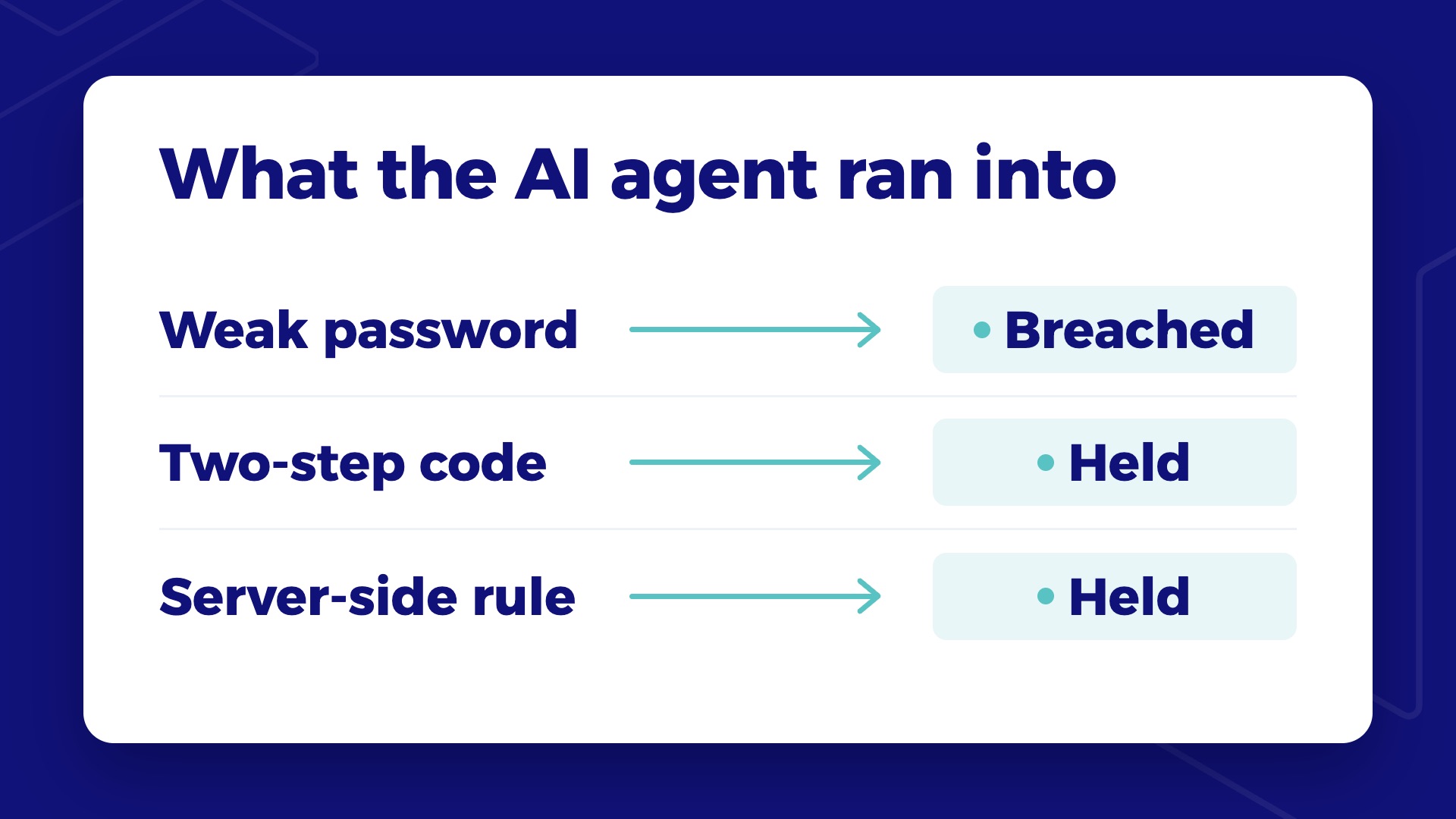
The SOCRadar analysis is just as useful for what failed. Of the 14 organisations it examined in depth, two were breached and three partly breached. Four resisted completely, and at five the agent got no further than reconnaissance.
- Two-step verification. At a payment provider, the agent wrote 11 scripts to get past a one-time code. None of them worked.
- Layered controls. At a crypto exchange, more than 180 scripts to forge tokens and bypass identity checks were stopped.
- Server-side checks. At a bank, a business rule on the server refused a fake death declaration that the agent tried to register.
These are basic measures, applied consistently. The agent could generate attempts faster than any human, but it could not get through a control that does not depend on a guessable secret. For a closer look at the password attacks involved, see credential stuffing versus password spraying.
How to close each door before an agent finds it
An agent can only attack what it can reach. Most of the doors above are about reach: who can see a system, and what a single password opens.
| Door used | Preventive control | How the Jimber SASE platform applies it |
|---|---|---|
| Management interface reachable from the internet | Keep admin interfaces off the public internet and open them only to verified users | Zero Trust Network Access gives users a path to approved applications only, while the rest of the network stays hidden |
| Weak administrator password | Make sure a password alone never opens access | Access follows identity and device: sign-in through your identity provider and a device posture check before every connection |
| Credentials left in configuration files | Rotate stored secrets and limit what each account can reach | Service-level segmentation keeps each connection scoped to its destination, which limits lateral movement |
| Data of all customers in one place, unencrypted | Separate and encrypt data per customer | This sits with the supplier, not the access layer: ask your suppliers how they store your data |
| Old software with known vulnerabilities | Patch, and replace systems that no longer get updates | Systems behind ZTNA are not exposed to the internet, which buys time but does not replace patching |
The ZTNA rule is simple: verify identity, device and policy first, then open an encrypted path to one approved application. A management console that is only reachable that way does not show up in an internet scan, so there is no login page for an agent to try passwords on. Once an account is compromised anyway, segmentation decides how far it gets. Our guide to lateral movement techniques explains why that matters.
You cannot secure your supplier's server
This breach started at a supplier, not at the municipalities. They could not have hardened the provider's server themselves. What every organisation does control is what its suppliers hold and how they reach its systems:
- Which personal data does the supplier keep for you, and does it need all of it?
- Is your data encrypted and kept apart from that of other customers?
- Is the supplier's management interface reachable from the internet, and is two-step verification enforced on it?
- When suppliers maintain your systems, do they get access to one application or to your network?
For that last question, see how to give third parties access without a VPN. Organisations that fall under NIS2 must manage these supplier risks as well, as explained in our article on NIS2 supply chain security obligations.
Five checks for this week
- List every management interface that can be reached from the internet: firewalls, storage, hypervisors, backup consoles and remote access portals.
- Enforce two-step verification on every administrator login, including the accounts your suppliers use.
- Ask your suppliers how they reach your systems and which of your data they store.
- Change the passwords that are stored in configuration files and scripts, especially those shared with suppliers.
- Check which systems no longer receive security updates. Our firewall and VPN end-of-life tracker lists the dates for twelve vendors.
Conclusion
AI did not give this attacker new doors. It let someone with little skill walk past many organisations at once and try the ones that were open: an exposed management interface, a weak password, readable credentials and old vulnerabilities. Where two-step verification and server-side checks were in place, the agent stopped.
The preventive answer is to reduce what can be reached. The Jimber SASE platform keeps internal applications and admin interfaces hidden behind Zero Trust Network Access, checks identity and device before every connection, and gives suppliers access to one application instead of the network. Jimber, the company behind it, is a Belgian vendor that builds for the European mid-market, including local governments.
Try Free with a pilot group, or book a demo to see which of your systems can be taken off the internet.
Frequently asked questions
What happened at the Belgian recycling parks?
Between 6 and 15 November 2026, an attacker took personal data linked to 82 Belgian municipalities from the server of a shared IT provider that manages recycling park data. The provider's management interface was reachable from the internet with a weak administrator password, and the files were not encrypted. The 82 municipalities together have about 1.2 million inhabitants.
Who is BabidiGhost?
BabidiGhost is the name of the operator behind the campaign, according to SOCRadar. The operator had little technical skill and let an AI agent do most of the work. The stolen data left through a Telegram account called GHOSTHUNTERS, which is why media also speak of "Ghost Hunters". The public prosecutor in East Flanders is investigating the case.
How did AI help the attacker?
The operator ran the open-source Hermes Agent framework, driven according to ITdaily by the DeepSeek model with its restrictions removed. The operator's 1,801 plain-language orders became 5,779 requests to the model in nine days. The agent wrote scripts, tested targets and retried refused requests, which gave a low-skilled attacker speed and scale.
Which data was stolen from the recycling parks?
Name, address, date of birth, gender, national register number, identity card number and bank account number, and for some municipalities licence plates. Passwords from municipal configuration files were also taken. There are no indications so far that the attacker entered the municipalities' own networks.
What stopped the AI agent?
Basic controls. At a payment provider, 11 scripts failed against two-step verification. At a crypto exchange, more than 180 scripts were stopped. At a bank, a server-side rule refused a fake death declaration. Of the 14 organisations SOCRadar examined in depth, four resisted completely.
Would Zero Trust Network Access have prevented this breach?
ZTNA addresses the way in. A management interface that is only reachable after identity and device checks is invisible to internet scans, and a password alone does not open it. ZTNA does not encrypt a supplier's data or separate its customers, so suppliers still need to store data securely.
What should local governments check first?
Start with what can be reached from the internet: management interfaces, remote access portals and supplier access. Enforce two-step verification on every administrator login, change passwords stored in configuration files, and ask suppliers how they store your residents' data and how they reach your systems.