
Segmentation vs micro-segmentation in the SASE era | 2026
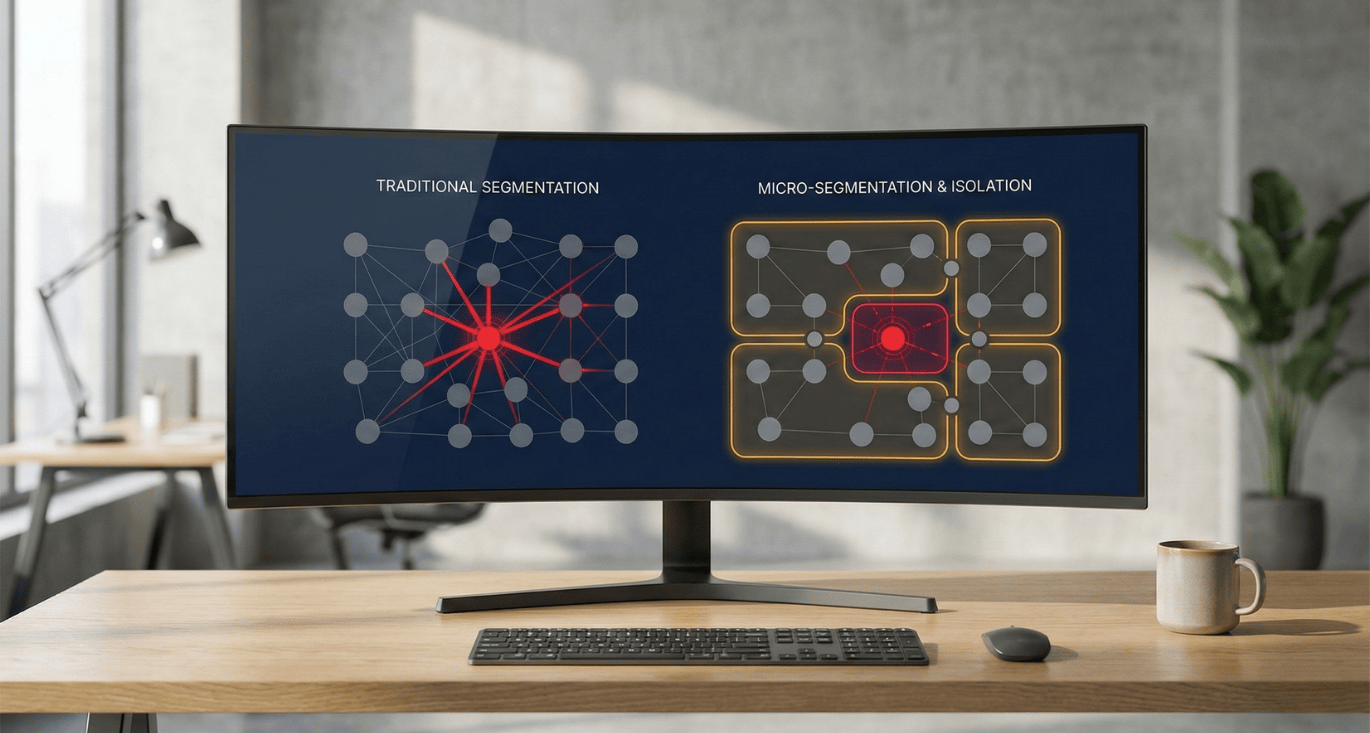
The perimeter security model has run its course. For years, organisations built high walls around their networks and trusted everything inside. With hybrid workforces and cloud-native infrastructure, the concept of “inside” has lost meaning. Once an attacker breaches that outer wall, usually through a phishing link or compromised credential, they often move freely from server to server.
This is where the distinction between segmentation and micro-segmentation becomes critical. If you are adopting a SASE architecture, understanding this difference is not semantics. It determines whether an incident stays contained or becomes a company-wide breach.
The difference between segmentation and micro-segmentation
Think of network segmentation like a submarine with bulkheads. If the hull is breached, you seal off a large section to save the ship. The damage is limited, but an entire compartment is still compromised.
Micro-segmentation works more like a vault full of individual safety deposit boxes. Even if someone gets into the bank and then into the vault room, they still cannot access your specific box without your specific key. Each asset is protected independently.
Network segmentation: the traditional approach
Network segmentation divides a network into subnetworks, typically using VLANs or subnets. It is hardware-centric and focuses primarily on north-south traffic, meaning traffic entering and leaving the network.
The approach groups assets by function. HR computers go in one VLAN, finance servers in another. This provides a baseline level of organisation and can improve network performance.
The limitation is scope. If an attacker compromises one HR laptop, they can typically reach every other device in that same VLAN. The segment itself becomes the blast radius. For network performance this may be adequate. For modern security it falls short.
Micro-segmentation: the Zero Trust standard
Micro-segmentation decouples security from the underlying hardware. It focuses on east-west traffic, the lateral movement between servers and applications within your environment.
The principle is straightforward. Never trust, always verify. Policies apply to individual workloads, applications, or users. Even if two servers sit physically next to each other, they cannot communicate unless explicitly allowed.
The goal is reducing blast radius. When a breach occurs, it stays contained within a single micro-zone, often just one device or application. Ransomware that might spread across an entire network segment instead hits a dead end.
Comparison at a glance
| Aspect | Traditional segmentation | Micro-segmentation |
|---|---|---|
| Granularity | Wide (zones, VLANs) | Fine (workload, app, user) |
| Traffic focus | North-south (in/out) | East-west (internal) |
| Policy basis | IP addresses, hardware | Identity and context |
| Agility | Static (hard to change) | Dynamic (follows the user) |
| Security model | Implicit trust within zone | Zero Trust, verify every request |
How SASE delivers micro-segmentation through isolation
Most SASE providers implement micro-segmentation through complex firewall rules in the cloud. While effective, this approach can become difficult to manage at scale.
There is another way. Instead of just blocking traffic, you can focus on isolation. In this model, micro-segmentation means the user and the application never actually touch directly. The attack surface effectively disappears.
ZTNA as the ultimate micro-segment
Traditional VPNs place remote users inside the network segment. Zero Trust Network Access takes a different approach.
When a user connects through ZTNA, they do not receive an IP address on your corporate network. They get access to one specific application only. The rest of the network is completely invisible to them.
If that user’s device becomes infected, the malware cannot scan your network because it has no network route to travel on. There is nothing to discover, nothing to exploit.
Browser isolation as a security barrier
Remote browser isolation applies micro-segmentation principles to web traffic. When an employee clicks a link, the website loads in an isolated cloud container. Only the visual rendering is sent to the user’s screen. Active code never reaches the endpoint.
If that website contains ransomware, it detonates inside a disposable container in the cloud. The container is deleted. Your network remains untouched. This stops threats before they even need to be segmented.
Identity-centric context
The security perimeter has moved from the network edge to identity itself. Micro-segmentation rules are based on who you are, not where you are.
Whether the user is in the office or at a coffee shop on the other side of the world, the same policies follow them. Access is granted only to the specific resources they are authorised to reach.
Why this matters for mid-market organisations
Relying on VLANs and firewalls alone creates liability. You cannot stop every breach at the perimeter, but you can stop a breach from becoming catastrophic.
Traditional segmentation organises your network. Micro-segmentation protects your assets. Isolation makes the attack surface disappear.
By combining Zero Trust principles with browser isolation and identity-based access, you move beyond simply dividing the network into zones. Each connection is verified. Each application is protected. Lateral movement hits a wall at every turn.
How Jimber makes micro-segmentation practical
Jimber delivers Real SASE through a unified platform that combines ZTNA, Secure Web Gateway, Firewall-as-a-Service, and SD-WAN. Micro-segmentation is built into the architecture, not bolted on as an afterthought.
Users connect to specific applications, not network segments. Device posture is verified before access is granted. For devices that cannot run agents, such as printers, IoT sensors, and industrial equipment, NIAC hardware provides inline isolation that closes common blind spots.
Everything is managed from a single cloud console with transparent pricing. MSPs and partners can serve multiple customers from one multi-tenant platform without juggling separate tools for each environment.
Ready to stop lateral movement?
Book a demo to see how isolation-based micro-segmentation protects your organisation without adding complexity.
Frequently asked questions
Is micro-segmentation only for large enterprises?
No. Mid-market organisations benefit significantly from micro-segmentation, especially when delivered through a unified SASE platform. The complexity that made it enterprise-only has been replaced by cloud-managed solutions that smaller teams can operate.
Do I need to replace my existing firewalls?
Not necessarily. Firewalls still serve a purpose for north-south traffic control. Micro-segmentation through ZTNA and isolation complements existing infrastructure by adding protection for east-west traffic and identity-based access.
How does this help with ransomware?
Ransomware spreads through lateral movement. Once it compromises one system, it looks for others to infect. Micro-segmentation limits what any single device can reach, containing an infection to a single micro-zone instead of allowing it to spread across the network.
What about devices that cannot run agents?
Printers, IoT sensors, and industrial equipment present a common challenge. NIAC hardware provides inline isolation for these agentless devices, allowing only defined communication flows while maintaining Zero Trust controls.
How does micro-segmentation support NIS2 compliance?
NIS2 requires demonstrable risk reduction and incident containment. Micro-segmentation provides clear evidence that access is limited to what is necessary and that breaches cannot spread unchecked through the network. Identity-based policies and centralised logging support the audit requirements.